
Key takeaways
- The question that decides the claim is not whether a hurricane caused the damage. It is how the water got into the house.
- Rain entering through an opening the wind created may fall under homeowners or windstorm coverage.
- Storm surge and rising surface water are flooding, and a standard homeowners policy generally does not cover them — no matter what produced the water.
- One hurricane can produce two claims, two adjusters, and two deductibles.
- Your hurricane deductible and your flood deductible are separate and work differently.
A hurricane damages your South Florida home. Wind tears shingles from the roof, rain enters through the opening, and rising stormwater eventually floods the first floor.
Does your homeowners insurance cover the damage?
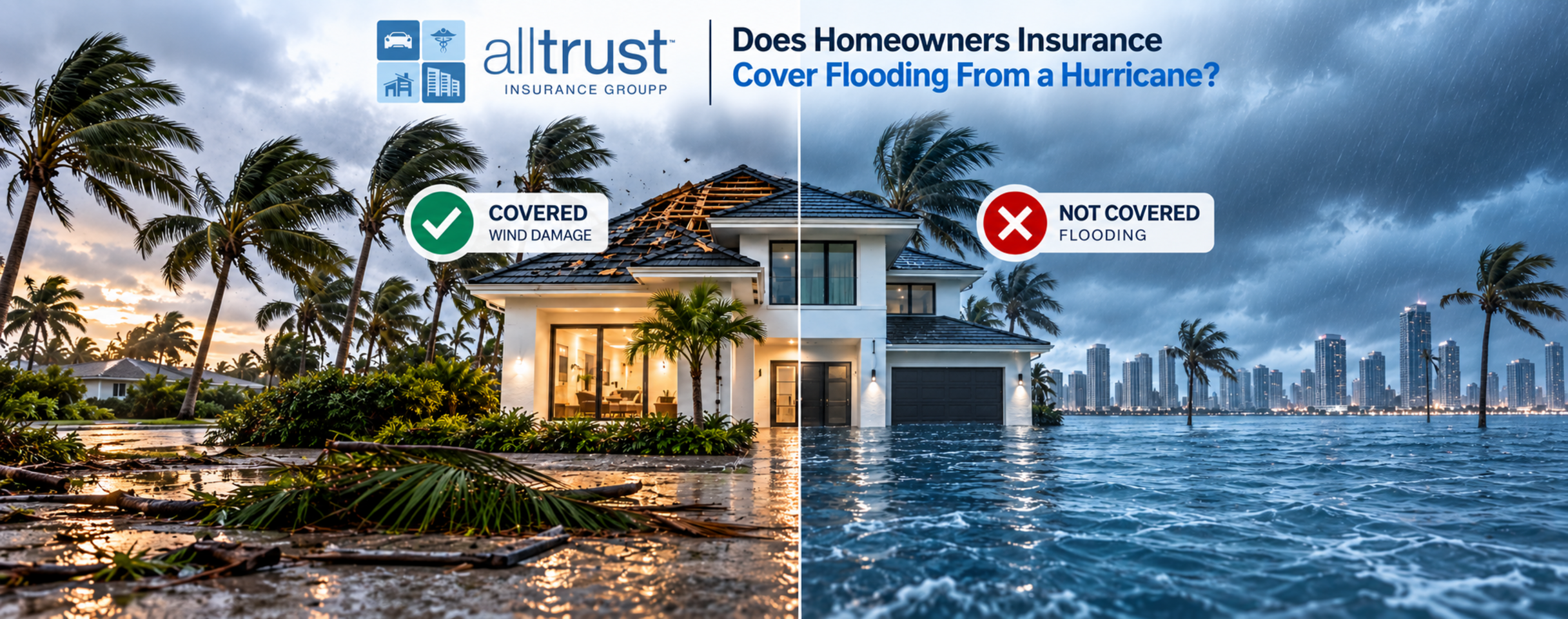
It depends on what actually caused each part of the loss. Florida homeowners insurance may cover certain damage caused by hurricane winds, and rain that enters after covered wind damage. But standard homeowners insurance generally does not cover flooding caused by rising water, storm surge, or surface-water flooding. That usually requires separate flood insurance.
The question that decides your claim: how did the water get in?
Homeowners tend to ask whether the hurricane caused the damage. Adjusters ask something narrower.
Water from above, or water from below?
Rain driven into the building through an opening the wind created generally comes in from above, and may be a wind claim. Water that rises from the ground and enters the structure — surge, overflow, or accumulated surface water — is generally a flood claim, regardless of whether a hurricane produced it.
That single distinction resolves most of the confusion, and it is worth understanding before a storm rather than during a claim.
Which policy pays? A hurricane scenario guide
The same hurricane can produce all of these on the same street:
| What happened | Generally treated as | Which policy may respond |
|---|---|---|
| Wind removes shingles; rain enters through the opening and damages ceilings and drywall. | Wind/hurricane loss | Homeowners or windstorm policy, subject to the hurricane deductible |
| Wind breaks a window; rain enters and damages flooring and furniture | Wind/hurricane loss | Homeowners or windstorm policy |
| Storm surge pushes ocean or tidal water into the house through the doors | Flood loss | Flood insurance policy |
| Hurricane rainfall overwhelms drainage; street and yard water rises and enters the home. | Flood loss | Flood insurance policy |
| A canal or waterway overtops, and water enters the ground floor | Flood loss | Flood insurance policy |
| Wind damages the roof, and surge floods the first floor in the same storm | Both | Two separate claims, two adjusters, two deductibles |
| Rain enters through an aging roof with no wind damage | Maintenance/wear | Often neither — commonly excluded |
| A tree falls on the roof, and rain enters | Wind / falling object | Homeowners policy, subject to policy terms |
This is a general guide, not a coverage determination. Every claim turns on the facts and on your specific policy language. But it shows why two neighbors with identical policies can have completely different outcomes after the same storm.
Does homeowners insurance cover hurricane damage in Florida?
It can cover certain types, depending on your policy.
Florida defines hurricane coverage as insurance for loss or damage caused by windstorm during a hurricane. That can include interior damage from rain when the wind first damages the building and creates an opening through which rain enters. Hurricane coverage does not include flooding.
So if hurricane-force winds tear part of the roof from your house and rain enters through the opening, that damage may fall under your homeowners or windstorm coverage, subject to the policy’s terms, exclusions, and hurricane deductible.
If the same hurricane pushes several feet of storm surge onto your property and water enters through your doors, that is a flood loss rather than a wind loss, and a standard homeowners policy generally will not cover it.
Does homeowners insurance cover storm surge?
Generally, no. Storm surge is flooding.
FEMA identifies hurricane storm surge as a type of flood, and Florida’s Department of Financial Services states that homeowners insurance does not cover flood damage.
This matters most for coastal South Florida homes—Miami Beach, Key Biscayne, Surfside, Bal Harbour, Sunny Isles Beach, Fort Lauderdale, and areas near Biscayne Bay and the Intracoastal Waterway. A hurricane does not have to touch your roof for surge to cause a catastrophic loss.
What about flooding caused by heavy hurricane rain?
This is where homeowners most often get caught out. Just because a hurricane produced the rain doesn't automatically make the resulting damage a homeowners claim.
If heavy rain accumulates outside your home, floods streets or yards, and rising surface water enters the house, that is generally flooding.
Florida’s Office of the Insurance Consumer Advocate gives essentially this example: when hurricane storm surge and rain cause water to rise around a house and flood into it, flood insurance rather than homeowners insurance would respond, because the damaging water was rising from the ground.
When wind and flood damage happen together
In a major hurricane, this is normal rather than unusual. Your homeowners or windstorm policy may respond to covered wind damage while your flood policy responds to qualifying flood damage.
FEMA advises that after a hurricane involving both wind and floodwater damage, a homeowner may need to file claims with both insurers and work with multiple adjusters. Practically, that means:
- Two claim numbers, two adjusters, and potentially two different repair timelines.
- Two deductibles, applied separately.
- Documentation that separates wind damage from water-line damage — photographs before cleanup begins are worth more than any argument made afterward.
- Disputes about which policy owns which portion of the loss, particularly where the two overlap.
Photograph everything, including the high-water line, before you remove anything. That record will separate the two claims later.
How the hurricane deductible and the flood deductible differ
This catches people out after a combined loss, and it is worth understanding in advance.
| Hurricane deductible | Flood deductible | |
|---|---|---|
| How it is set | Typically a percentage of Coverage A — commonly 2%, 5%, or 10% | Typically a flat dollar amount, selected separately |
| What it applies to | Covered hurricane or windstorm damage | Covered flood damage |
| Structure | One deductible applied to the hurricane loss | Often separate deductibles for building and contents |
| After a combined loss | Applies to the wind portion | Applies to the flood portion — both can apply from one storm |
Because the hurricane deductible is a percentage rather than a flat figure, the dollar amount can be larger than homeowners expect. On an $800,000 home, a 5% hurricane deductible is $40,000. We cover the arithmetic in more detail in our guide to lowering a South Florida homeowners insurance premium.
What does flood insurance cover after a hurricane?
Flood insurance covers direct physical loss caused by flooding, subject to the policy’s limits, deductibles, and exclusions. Depending on the policy and the coverage purchased, it can protect both the building and personal property.
Building coverage commonly includes the insured building and foundation, electrical and plumbing systems, central air-conditioning equipment, furnaces and water heaters, refrigerators and cooking stoves, and certain built-in appliances. Contents coverage provides separate protection for qualifying personal belongings, but it is not automatic, so check whether you have it.
Exact coverage depends on whether the policy is written through the NFIP or the private flood market, and on the specific terms. We compare the two in detail in our guide to flood insurance for Florida homes outside high-risk flood zones, including limits, waiting periods, additional living expense, and what to compare beyond premium.
Do not wait until a hurricane is in the forecast
Flood insurance is not something to buy once a storm appears on the cone.
NFIP flood policies generally have a 30-day waiting period before coverage takes effect, subject to certain exceptions. Private flood insurers may have different waiting periods and underwriting requirements. Waiting until a named storm is approaching South Florida usually means you cannot put coverage in place for that event.
Flood risk also is not confined to high-risk zones. A meaningful share of flood claims come from properties outside FEMA-designated high-risk areas, and South Florida’s combination of heavy rainfall, low elevation, flat terrain, and drainage capacity means flooding is not limited to homes on the water. Your lender not requiring flood insurance is a different statement from your home having no flood risk.
Best first move
Review your homeowners or windstorm policy and your flood coverage side by side. Confirm your hurricane deductible, whether wind coverage is included, your flood limits, whether you have contents coverage, and exactly which policy would respond if rising water entered your home. Do it before June, not in August.
Frequently asked questions
Does homeowners insurance cover hurricane flooding in Florida?
Generally, no. Standard homeowners insurance does not cover flooding caused by rising water. You generally need separate flood insurance for storm surge and qualifying surface-water flooding, even when a hurricane produced the water.
Does homeowners insurance cover rain damage during a hurricane?
It can, depending on how the rain entered and on your policy terms. If hurricane winds first damage the building and create an opening through which rain enters, the resulting damage may fall within hurricane or windstorm coverage.
Is storm surge considered flood damage?
Yes. Storm surge from a hurricane is a type of flooding, and standard homeowners insurance generally does not cover it.
Can I have a homeowners claim and a flood claim from the same hurricane?
Yes, and in a major storm it is common. Depending on the circumstances, you may have claims under both your homeowners or windstorm policy and your flood policy, with separate adjusters and separate deductibles.
Does my hurricane deductible apply to my flood claim?
No. The hurricane deductible on your homeowners policy relates to covered hurricane or windstorm damage. Flood insurance is separate coverage with its own deductible structure, often with separate building and contents deductibles. After a combined loss, both can apply.
What if the adjusters disagree about whether damage was wind or water?
This happens, particularly along the water line where both causes may be present. Thorough documentation before cleanup — photographs, video, the high-water line, and dated records — is the single most useful thing you can have. Your agent can help you understand each policyis position.
Does flood insurance cover my belongings after a hurricane?
Only if you purchased contents coverage. It is not automatic, and the settlement basis, deductible, and limits deserve a look before hurricane season rather than after a loss.
Do I need flood insurance in Miami if I am not in a high-risk flood zone?
It may still make sense. Flooding occurs outside FEMA-designated high-risk areas, and a meaningful percentage of flood claims come from those areas.
Get a South Florida homeowners and flood insurance review
Alltrust Insurance Group helps homeowners throughout Miami-Dade, Broward, and Palm Beach understand the difference between homeowners, hurricane, windstorm, and flood insurance — and find the gaps between them before a storm does.
We can review your existing coverage, compare available NFIP and private flood options, and tell you plainly which policy would respond to which kind of loss at your address.
Coverage, limits, deductibles, exclusions, waiting periods, and eligibility vary by insurer, property, and policy. Nothing here is a coverage determination for any particular claim. This guide is general information, not a quote or a policy. The insurance contract controls.
- Florida Department of Financial Services — Homeowners Insurance
- Florida Office of the Insurance Consumer Advocate — Flood Insurance
- FEMA / National Flood Insurance Program — Flood Insurance Basics
- Florida Department of Financial Services — Florida’s Hurricane Deductible
- FEMA — Wind Damage Versus Floodwater Damage