
Key takeaways
- Florida law places several categories of interior property — flooring, cabinets, countertops, appliances, and electrical fixtures outside the association’s required coverage. Those are yours to insure.
- Florida HO-6 policies must carry at least $2,000 in property loss assessment coverage. On a large loss with a big association deductible, $2,000 is often nowhere near enough.
- Loss assessment coverage responds to assessments arising from a covered loss. It generally does not cover assessments for structural repairs, reserves, or deferred maintenance.
- A single hurricane can involve three policies: the association’s master policy, your HO-6, and a separate flood policy.
- Your condo’s market value is not the number that determines how much HO-6 coverage you need.
If you own a condo in Miami-Dade, Broward, Palm Beach, or elsewhere in South Florida, your condominium association probably carries a master insurance policy. That does not mean everything inside your unit is insured.
Your floors, cabinets, appliances, furniture, personal belongings, liability exposure, and certain assessments can be your responsibility. That is where an HO-6 condo insurance policy comes in.
Understanding where the association’s master insurance ends and your individual coverage begins matters more in South Florida than almost anywhere else. Hurricanes, water losses, high-value interior renovations, flood exposure, and large association deductibles can turn a coverage gap into a substantial out-of-pocket expense.
What is HO-6 condo insurance in Florida?
An HO-6 policy — commonly called condo insurance or condominium unit-owner insurance — is designed to protect a condo owner’s individual insurance interests.
Unlike a traditional homeowners policy that insures an entire single-family home, an HO-6 works alongside the condominium association’s master insurance policy. The association generally insures portions of the building and common property. Your HO-6 can cover property within your unit that you own, plus personal belongings, personal liability, loss of use, and loss assessment coverage.
So the question every South Florida condo owner should be able to answer is simple: what does my association insure, and what do I have to insure myself?
What does a Florida condo association’s master policy cover?
Under Florida Statute § 718.111, a residential condominium association’s property insurance generally must cover portions of the condominium property as originally installed, or replacements of like kind and quality, subject to Florida law and the terms of the master policy.
Several categories of property inside an individual unit, however, are generally excluded from the association’s required property coverage. Here is roughly where the line falls:
| Generally the association’s responsibility | Generally the unit owner’s responsibility |
|---|---|
| Roof, exterior walls, and structural members | Floor, wall, and ceiling coverings |
| Common elements and common property | Built-in cabinets and countertops |
| Building systems serving more than one unit | Appliances, water heaters, and water filters |
| Unfinished interior surfaces within the unit | Electrical fixtures |
| Property as originally installed, or like kind and quality replacement | Window treatments, including blinds, curtains, and hardware |
| — | Personal property inside the unit or limited common elements |
| — | Interior improvements and renovations you installed |
Items in the right-hand column, when located within the unit boundaries and serving only that unit, are generally the condo owner’s insurance responsibility.
Your own association’s declaration can shift some of these lines, so the table above is a starting point rather than the final word. But the broader point holds: “my association has insurance” should never be read as “everything in my condo is covered.”
What does an HO-6 condo insurance policy cover?
1. Interior building property and improvements
Your HO-6 can cover the portions of the condo that are your responsibility rather than the association’s. Depending on the policy and circumstances, that can include flooring, built-in cabinets, countertops, electrical fixtures, and other permanently installed property within the unit.
This matters enormously in the South Florida luxury condo market. If you replaced the original flooring with marble or hardwood, installed custom cabinetry, upgraded countertops, or completed a major kitchen or bathroom renovation, your HO-6 limits should reflect what it would actually cost to replace that work. A condo’s purchase price tells you nothing about how much interior coverage you need.
2. Personal property
Furniture, clothing, electronics, artwork, and other belongings can be covered by the personal-property section of an HO-6 when damaged by a covered cause of loss.
Two things to check. First, whether the policy settles personal-property claims at replacement cost or actual cash value — that difference can be substantial after a major loss. Second, the special limits that apply to jewelry, watches, fine art, and collectibles. Valuable items often need to be scheduled separately to be fully covered.
3. Personal liability
Your association’s liability insurance does not replace your own. An HO-6 typically provides personal liability protection if you are legally responsible for covered bodily injury or property damage to another person — a guest injured inside your unit, or a covered incident originating in your unit that damages a neighboring one.
Condo owners with significant assets should also ask whether their liability limit is adequate, and whether a personal umbrella policy makes sense on top of it.
4. Loss of use
If a covered fire, hurricane, or other insured loss makes your condo temporarily uninhabitable, loss-of-use coverage can help pay qualifying additional living expenses. While the unit is repaired, subject to policy limits and conditions.
In South Florida condominiums, this is not a minor coverage. A significant building loss can mean a repair timeline measured in months, not weeks, and housing in the meantime is not cheap in this market.
5. Loss assessment coverage
Loss assessment is one of the most important and most misunderstood parts of Florida condo insurance.
A condominium association may assess individual unit owners for their share of certain covered losses involving commonly owned property.
Under Florida Statute § 627.714, a Florida unit owner’s residential property policy must include at least $2,000 in property loss assessment coverage for all assessments resulting from the same direct loss, with a deductible of no more than $250 applying to that coverage. The statute also provides that if a deductible was or will be applied to other property loss from the same direct loss, no deductible applies to the loss assessment coverage — a detail many owners never learn until a claim.
The statutory minimum, though, is a floor and not a target. Here is why:
| Scenario | Amount |
|---|---|
| Association assessment to each unit owner after a covered loss | $10,000 |
| Your HO-6 loss assessment limit (statutory minimum) | $2,000 |
| Potentially paid by the HO-6 policy. | Up to $2,000 |
| Potentially your out-of-pocket | $8,000 |
That is a simplified illustration, not a promise of how any particular claim resolves. But the shape is real, and higher loss-assessment limits are often available for a modest additional premium. It is worth asking, particularly if your building carries substantial property values or a large windstorm deductible.
One more point that catches people out: not every condo special assessment is covered. Assessments for routine maintenance, reserves, structural improvements, or causes of loss your policy excludes should not be assumed to be covered.
What the milestone inspection and SIRS rules mean for your condo insurance
This is where many South Florida condo owners are getting an unpleasant surprise, and it is worth separating carefully from the loss assessment coverage above.
Florida requires milestone structural inspections for condominium and cooperative buildings with three or more habitable stories under Florida Statute § 553.899, generally at 30 years of age—or 25 years for buildings within three miles of the coast, which covers much of South Florida. Separately, Florida Statute § 718.112(2)(g) requires a Structural Integrity Reserve Study (SIRS) covering eight structural components, and associations may no longer vote to waive or underfund reserves for those components.
The insurance point
An assessment to fund structural repairs, reserve shortfalls, or deferred maintenance identified by a milestone inspection or SIRS does not arise from a covered direct loss. Loss assessment coverage on your HO-6 is generally not designed to respond to it.
This is worth stating plainly because the two get conflated constantly. Loss assessment coverage exists for assessments following a covered event — a hurricane, a fire, a large covered water loss. It is not a backstop for a building that needs concrete restoration.
There is also an eligibility dimension. Recent Florida legislation ties Citizens Property Insurance eligibility to an association’s compliance with milestone inspection and SIRS requirements, and private carriers have been applying their own scrutiny to buildings that are behind. If you are buying into a building, or your association is working through compliance, ask your agent how it affects both the master policy and your own HO-6 options before you assume nothing changes.
Does HO-6 insurance cover hurricanes in South Florida?
An HO-6 can cover certain hurricane and wind damage when wind is a covered cause of loss, subject to the policy’s deductible, limits, exclusions, and other terms.
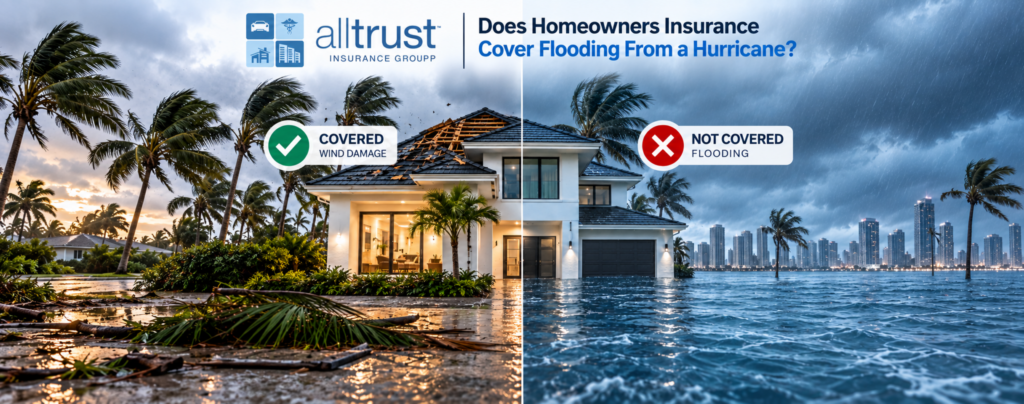
But hurricane coverage and flood coverage are not the same thing. If hurricane winds damage covered property inside your condo, your HO-6 may respond according to its terms. If storm surge or rising floodwater enters the building and damages your unit, a standard HO-6 generally does not provide flood coverage. See whether homeowners insurance covers hurricane flooding.
That distinction is especially sharp for coastal condos in Miami Beach, Sunny Isles Beach, Bal Harbour, Surfside, Key Biscayne, Fort Lauderdale, and Hollywood.
One hurricane can potentially involve three separate policies:
- The condominium association’s master policy
- Your individual HO-6 policy
- A separate flood insurance policy
Figuring out which is which before a storm is much easier than doing it afterward.
Does HO-6 condo insurance cover water damage?
Sometimes. The water source matters.
A sudden, accidental discharge from a covered plumbing event is treated very differently from flooding, storm surge, repeated leakage, seepage, or damage traced to a maintenance issue. A sudden covered plumbing loss originating in your unit or a neighboring one may trigger coverage depending on the facts and the policy language. Rising water entering the building from outside is generally flooding and requires separate flood insurance.
Review water coverage carefully. In multi-unit buildings, a single water loss can travel through several units, which can quickly complicate questions about who pays. Do not assume that because your policy covers some kinds of water damage, it covers every way water can get into your condo.
Do South Florida condo owners need flood insurance?
Potentially — even if your association already carries flood insurance.
A standard HO-6 generally does not cover flooding. The association may maintain a flood policy on the building, but that does not necessarily protect your individual property or financial exposure. Your furniture, personal belongings, and interior improvements may need separate consideration depending on what the association’s policy actually covers.
This matters most for condos near the water, but being farther inland does not mean zero flood risk — a meaningful share of NFIP flood claims come from outside high-risk flood zones. Review the association’s flood policy alongside your own coverage before assuming you are adequately protected.
How much HO-6 condo insurance do I need in South Florida?
No single coverage amount is right for every condo. The process, though, is the same everywhere.
Start with what the association must insure. Review the declaration, bylaws, insurance responsibilities, and master policy. Then work out what it would cost to replace the property you are responsible for. Pay particular attention to:
- Flooring, cabinets, countertops, and appliances
- Electrical fixtures and other permanently installed property
- Interior improvements and renovations
- Furniture and personal belongings
- Jewelry, watches, artwork, and other valuables that may need scheduling
- Personal liability limits
- Loss-of-use coverage
- Loss assessment limits
- Water damage coverage and exclusions
- Hurricane and wind deductibles
- Flood exposure, separate from the association’s policy
A $1 million Miami condo with original finishes has very different HO-6 needs from a $1 million condo carrying $300,000 of custom interior work. The unit's market value isn't the number to build the policy around.
5 common condo insurance mistakes in South Florida
1. Assuming the master policy covers everything
It does not. Florida law places several categories of interior property on the individual unit owner.
2. Insuring the condo based on its market value
Your HO-6 is not insuring the building or the land. Coverage should reflect your actual insurance responsibilities and property exposure.
3. Forgetting to insure renovations and upgrades
New flooring, custom cabinetry, expensive countertops — review your limits after the work is done, not years later when you file a claim.
4. Carrying only the minimum loss assessment coverage
The $2,000 statutory minimum can be a small fraction of a real assessment after a large covered loss. Ask what higher limits cost.
5. Assuming hurricane coverage includes flood
Wind and flood are different causes of loss, and one hurricane can produce both. Review flood exposure separately.
Best first move
Send your agent your current HO-6 declarations page and, when you can get it, information about your association’s master insurance program — including the master policy deductible. Ask the agent to identify exactly where the association’s coverage stops and yours begins. That one exercise surfaces most of the gaps described above.
Frequently asked questions about South Florida condo insurance
Is HO-6 condo insurance required in Florida?
Whether you must maintain an HO-6 can depend on your mortgage lender, your condominium documents, and other circumstances. Even when it is not required, going without coverage leaves you personally exposed to substantial property and liability risk.
What is the difference between an HO-6 policy and condo master insurance?
The master policy generally protects property the association is responsible for insuring. Your HO-6 protects your individual interests — certain interior property, personal belongings, personal liability, loss of use, and loss assessment. They are designed to work together, and the seam between them is where coverage gaps live.
Does HO-6 insurance cover floors and cabinets?
Florida law generally places floor coverings, built-in cabinets, and countertops located within and serving only the individual unit outside the association’s required property coverage. Review your own HO-6 to confirm how those items are insured and at what limit.
What is loss assessment coverage on a Florida HO-6 policy?
It can help pay your share of certain assessments arising from a qualifying covered loss involving commonly owned condominium property. Florida HO-6 policies must provide at least $2,000 of property loss assessment coverage, with a deductible of no more than $250 applying. Higher limits are often available.
Does HO-6 insurance cover a condo special assessment?
Not automatically. The assessment generally must arise from circumstances covered by the loss assessment provisions of your policy. Assessments for maintenance, reserves, improvements, or excluded causes of loss should not be assumed to be covered.
Does my HO-6 cover a milestone inspection or SIRS assessment?
Generally no. An assessment to fund structural repairs or reserve shortfalls identified by a milestone inspection or Structural Integrity Reserve Study does not arise from a covered direct loss. Therefore, loss assessment coverage typically isn't designed to respond to it. Confirm with your agent how your specific policy reads.
Why did my condo insurance go up this year?
Common drivers include changes in the association’s master policy and deductible, reconstruction cost increases, carrier appetite shifting in your building or ZIP code, the building’s milestone inspection and SIRS status, and statewide rate filings. Ask which specific factor moved rather than accepting the renewal number.
Does South Florida condo insurance cover hurricane damage?
An HO-6 may cover certain wind or hurricane damage when the policy covers that cause of loss. Flood and storm surge are generally separate exposures and should be reviewed independently.
Do I need flood insurance for my South Florida condo?
Potentially. Your association’s flood insurance does not necessarily protect all of your personal property, interior improvements, or other individual exposures. Review the association’s flood policy and your own needs with an insurance professional.
Get a South Florida condo insurance review.
Alltrust Insurance Group helps condo owners throughout Miami-Dade, Broward, and Palm Beach review their HO-6 coverage and identify the gaps between the association’s master policy and their own.
We can help you evaluate interior building coverage, personal property, liability, loss of use, loss assessment limits, hurricane exposure, and flood insurance. So you understand what your policy covers and, just as importantly, what it does not.
Coverage, limits, deductibles, exclusions, loss assessment coverage, and eligibility vary by insurer, condominium, property, and underwriting. Statutory requirements change; confirm current law and your association’s governing documents before making coverage decisions. This guide is general information, not legal advice, a quote, or a policy. The insurance contract controls.
- Florida Statutes § 718.111 — Condominium Association Insurance
- Florida Statutes § 627.714 — Residential Condominium Unit Owner Coverage and Loss Assessment
- Florida Statutes § 553.899 — Mandatory Structural Inspections for Condominium and Cooperative Buildings
- Florida Statutes § 718.112 — Bylaws, including Structural Integrity Reserve Study requirements
- Florida Department of Financial Services — Homeowners and Condominium Insurance