
Key takeaways
- A standard Florida homeowners insurance policy generally does not cover flood damage — in any flood zone.
- About 29% of NFIP flood claims from 2014 through 2024 came from properties outside current high-risk flood zones.
- “Not in a flood zone” usually means Zone X — lower risk, not no risk.
- As little as one inch of floodwater can cause up to $25,000 in damage to a home.
- NFIP policies generally carry a 30-day waiting period, so coverage has to be in place well before a storm is in the forecast.
If you own a home in Florida and you are not in a high-risk flood zone, it is easy to assume you do not need flood insurance. That assumption can be expensive. Every property in Florida carries some level of flood risk, and FEMA reports that nearly one-third of National Flood Insurance Program (NFIP) flood claims from 2014 through 2024 came from areas outside current high-risk flood zones.
The more useful question is not whether your home sits inside a flood zone. It is how much flood risk your property actually has, what your homeowners policy excludes, and whether transferring that risk to a flood insurance policy makes financial sense for you.
Does homeowners insurance cover flood damage in Florida?
Generally, no.
A standard Florida homeowners insurance policy typically does not cover flood damage. If rising water enters your home because of heavy rainfall, storm surge, overflowing canals, or other qualifying surface-water flooding, your homeowners policy generally will not pay for that flood damage.
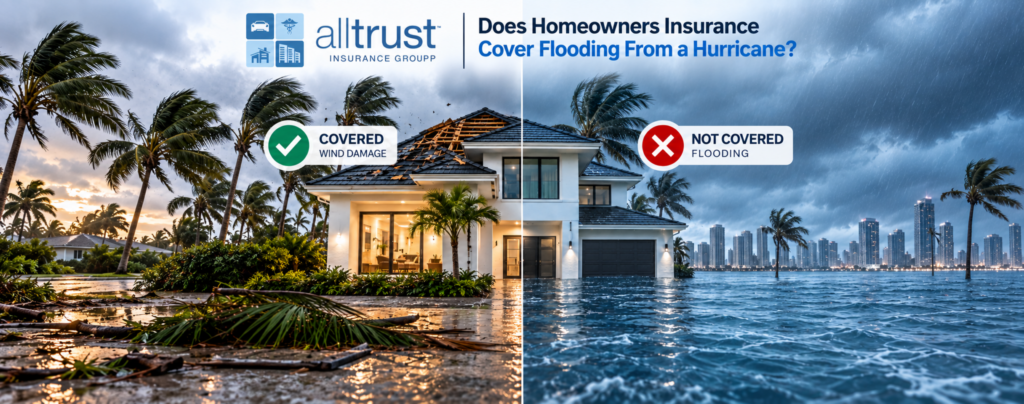
That distinction matters in South Florida, where a single hurricane can produce several different types of damage at the same time. Wind-driven damage may fall under a homeowners or wind policy, while damage caused by rising floodwater may require a separate flood insurance policy. We explain the split in Does homeowners insurance cover flooding from a hurricane?
Do not assume that carrying homeowners and hurricane coverage means you are insured against every type of water damage.
What does “I’m not in a flood zone” actually mean?
Technically, every property is in a FEMA flood zone. What most homeowners mean when they say they are “not in a flood zone” is that their property sits outside a Special Flood Hazard Area (SFHA) — what is commonly called a high-risk flood zone.
FEMA generally identifies high-risk areas with flood zone designations beginning with A or V. Lower- and moderate-risk areas may carry designations such as B, C, or X. You can look up your own designation on the FEMA Flood Map Service Center or through FloodSmart’s flood zone lookup.
Florida flood zone designations at a glance
| Zone | Risk level | What it usually means for flood insurance |
|---|---|---|
| A, AE, AO, AH | High risk (SFHA) | Flood insurance is typically required with a federally backed mortgage. |
| V, VE | High risk, coastal | High risk with added storm-wave hazard; typically required with a federally backed mortgage. |
| B or shaded X | Moderate risk | Usually optional, but commonly recommended. |
| C or unshaded X | Lower risk | Usually optional. Lower risk is not the same as no risk. |
| D | Undetermined | Flood hazard has not been analyzed; risk is possible but unstudied. |
Being in Zone X does not mean there is zero chance of flooding. It means FEMA has classified the property as having a lower flood risk than properties in designated high-risk areas.
That difference matters. From 2014 through 2024, approximately 29% of NFIP flood claims came from properties outside current high-risk flood areas. Lower risk is not the same thing as no risk.
Why do homes flood outside high-risk flood zones in South Florida?
South Florida has several characteristics that make flood insurance worth considering even when a lender does not require it.
Heavy rainfall
A slow-moving tropical system or a severe afternoon storm can drop enormous amounts of rain in a short period. Streets and drainage systems can be overwhelmed before the water has anywhere to go.
Low elevation and flat terrain
Much of South Florida is relatively flat and close to sea level. Water does not always drain quickly, and flooding can occur far from a beach, canal, or other obvious body of water.
Storm surge
Coastal properties in Miami-Dade, Broward, and Palm Beach face storm-surge exposure during hurricanes and tropical storms. Flood damage caused by rising storm surge is generally not covered by a standard homeowners policy.
Drainage and new development
New construction and changes to surrounding land can alter how water moves through a neighborhood. A property that has never flooded before is not guaranteed to stay flood-free.
Changing flood conditions and flood map updates
Flood maps are useful tools, but they should not be treated as a prediction of whether an individual property will ever flood. FEMA updates flood maps as development, weather patterns, and terrain change, and FEMA itself states that every zone carries some degree of flood risk. FEMA’s guide to reading a Flood Insurance Rate Map explains how those designations are drawn.
Is flood insurance required in Florida?
Florida law does not generally require every homeowner to purchase flood insurance.
However, a mortgage lender may require it depending on the property’s flood zone, the loan type, and other requirements. Properties in FEMA-designated high-risk flood areas with certain federally backed mortgages generally must carry flood insurance.
Certain Florida property insurance arrangements may also carry separate flood-insurance requirements, including requirements affecting some Citizens Property Insurance policyholders.
But “my lender doesn’t require it” and “I don’t need it” are two different statements.
A lender’s requirement is designed primarily to protect the lender’s financial interest in the property. Your decision should consider how much of your own money is exposed if flooding damages the house.
How much damage can one inch of flooding cause?
It does not take several feet of water to cause an expensive loss.
According to Florida’s Office of the Insurance Consumer Advocate, just one inch of floodwater can cause up to $25,000 in damage to a home.
Water can damage flooring, drywall, cabinets, electrical components, HVAC equipment, appliances, furniture, and personal belongings. Cleanup and remediation can add significantly to the cost.
For a South Florida homeowner with substantial equity in a property, the question becomes fairly straightforward: could you comfortably absorb a major flood loss without insurance? If the answer is no, getting a flood insurance quote is worth your time even when coverage is optional.
NFIP vs. private flood insurance in Florida
Florida homeowners may have more than one option for buying flood coverage.
National Flood Insurance Program (NFIP)
FEMA manages the NFIP. NFIP policies can cover the building and, when selected, personal property, subject to the policy’s limits, deductibles, exclusions, and conditions. NFIP coverage is standardized, which can make it easier to compare from one property to another.
Private flood insurance
Florida also has an active private flood insurance market. Depending on the insurer and policy form, private coverage may offer different limits, deductibles, or coverage features than an NFIP policy. Florida law recognizes several types of private flood policies, including standard, preferred, customized, flexible, and supplemental flood insurance.
For some properties, private flood insurance may offer broader coverage or higher limits than the NFIP. For others, the NFIP may be the better fit.
How the two options compare
| Consideration | NFIP | Private flood insurance |
|---|---|---|
| Coverage limits | Standardized federal limits | May offer higher limits, depending on insurer |
| Policy form | Uniform across insurers | Varies by insurer and policy form |
| Additional living expense | Not provided under the Standard Flood Insurance Policy | May be available, depending on the policy form |
| Waiting period | Generally 30 days, subject to exceptions | Varies by insurer |
| Lender acceptance | Broadly accepted | Depends on the lender and the policy |
| Best suited for | Straightforward comparisons and standard exposures | Higher-value homes or coverage gaps the NFIP does not fill |
The right comparison is not simply NFIP premium versus private premium. Compare coverage limits, contents coverage, deductibles, replacement-cost provisions, additional living expense coverage, exclusions, waiting periods, and the financial strength of the insurer.
What should I compare when shopping for flood insurance?
Do not compare flood policies on premium alone. Ask your agent to walk you through:
- Building coverage and limits
- Personal-property (contents) coverage
- Building and contents deductibles
- Replacement cost versus actual cash value
- Additional living expense coverage
- Coverage for basements or below-grade areas, where applicable
- Waiting periods before coverage takes effect
- Exclusions and limitations
- Whether the policy satisfies your lender’s requirements
- NFIP versus private-market options
One difference can matter a great deal after a serious loss: the NFIP Standard Flood Insurance Policy does not provide additional living expense coverage. Certain private-market policies may offer it, depending on the policy form.
When should I buy flood insurance in Florida?
Before you need it.
Flood insurance should not be treated as something you can buy once a hurricane appears in the forecast. New flood policies may have waiting periods before coverage takes effect.
NFIP policies generally have a 30-day waiting period, subject to certain exceptions. Private flood insurers may have different waiting periods and underwriting requirements.
Waiting until a named storm is approaching South Florida may leave you with limited or no ability to put coverage in place for that event.
Flood insurance for Miami-Dade, Broward, and Palm Beach homeowners
Flood exposure in South Florida is highly local. Two homes a few blocks apart can sit in different flood zones, at different elevations, with different drainage behind them.
- Miami-Dade County — Coastal barrier-island properties in Sunny Isles Beach, Miami Beach, and Key Biscayne face storm-surge exposure, while inland neighborhoods in Kendall, Doral, and Cutler Bay can see rainfall-driven street flooding.
- Broward County — Extensive canal networks and low elevation in cities such as Fort Lauderdale, Hollywood, and Pembroke Pines mean drainage capacity often determines how a neighborhood performs in a heavy-rain event.
- Palm Beach County — Coastal and western communities carry very different exposures, and flood zone designations vary widely within short distances.
Because of that variation, a flood insurance review should start with your specific address rather than a general assumption about your city or ZIP code.
Frequently asked questions about Florida flood insurance
Do I need flood insurance if I live in FEMA Zone X?
Flood insurance may not be required solely because your property is in Zone X, but Zone X does not mean there is no flood risk. FEMA data shows that a meaningful percentage of flood claims occur outside designated high-risk areas. Consider the property’s individual exposure and the financial consequences of an uninsured flood.
Does homeowners insurance cover storm surge in Florida?
Standard homeowners insurance generally does not cover flood damage caused by rising water, including qualifying storm surge. Wind and flood damage from the same hurricane may therefore fall under different policies.
Does flood insurance cover my belongings?
Flood policies may offer contents coverage, but it is not automatic. Review the contents coverage amount, settlement method, deductible, and exclusions before purchasing.
Can I buy private flood insurance instead of FEMA flood insurance?
Potentially. Florida has both NFIP and private flood insurance options. Eligibility, coverage, and lender acceptance depend on the property, the policy, and the insurer.
Is flood insurance cheaper if I am not in a high-risk flood zone?
Flood risk is one factor used in pricing, so a lower-risk property may cost less to insure than a property with greater flood exposure. However, current NFIP and private-market pricing considers multiple characteristics of the individual property. The only way to know your cost is to obtain quotes.
How much does flood insurance cost in Florida?
There is no single answer. Pricing generally reflects the structure’s elevation, foundation type, construction, distance to a water source, coverage limits, deductible selection, and whether the policy is written through the NFIP or the private market. Two homes on the same street can price very differently.
Do condo owners in Florida need flood insurance?
It depends on the association’s master policy and the unit owner’s exposure. A condominium association may carry flood coverage on the building, but that coverage may not extend to everything inside an individual unit. Unit owners should review their HO-6 policy and the association’s coverage together.
My house has never flooded. Do I still need flood insurance?
A property’s claims history is useful information, but the absence of a previous flood does not mean a future flood cannot occur. Heavy rainfall, drainage changes, tropical systems, and other conditions can cause flooding in areas that have not experienced it before.
Get a South Florida flood insurance quote
Alltrust Insurance Group helps South Florida homeowners evaluate their flood exposure and compare available NFIP and private flood insurance options.
If your home is in Miami-Dade, Broward, Palm Beach, or elsewhere in Florida, we can review the property’s flood zone, your current insurance coverage, and the flood insurance options available to you — so you can decide whether purchasing coverage makes sense.
Even if your lender does not require flood insurance, a quote lets you compare the cost of transferring the risk against what you could have to pay out of pocket after a flood.
Coverage, limits, deductibles, waiting periods, eligibility, and pricing vary by insurer, property, and underwriting. This guide is general information, not a quote or a policy. The insurance contract controls.
- FEMA / National Flood Insurance Program — Flood Zones and Flood Risk
- FEMA Flood Map Service Center
- FEMA — How to Read a Flood Insurance Rate Map
- Florida Department of Financial Services — Office of the Insurance Consumer Advocate, Flood Insurance
- Florida Department of Financial Services — Flood Insurance Coverage FAQs
- Florida Division of Emergency Management — Flood Insurance