

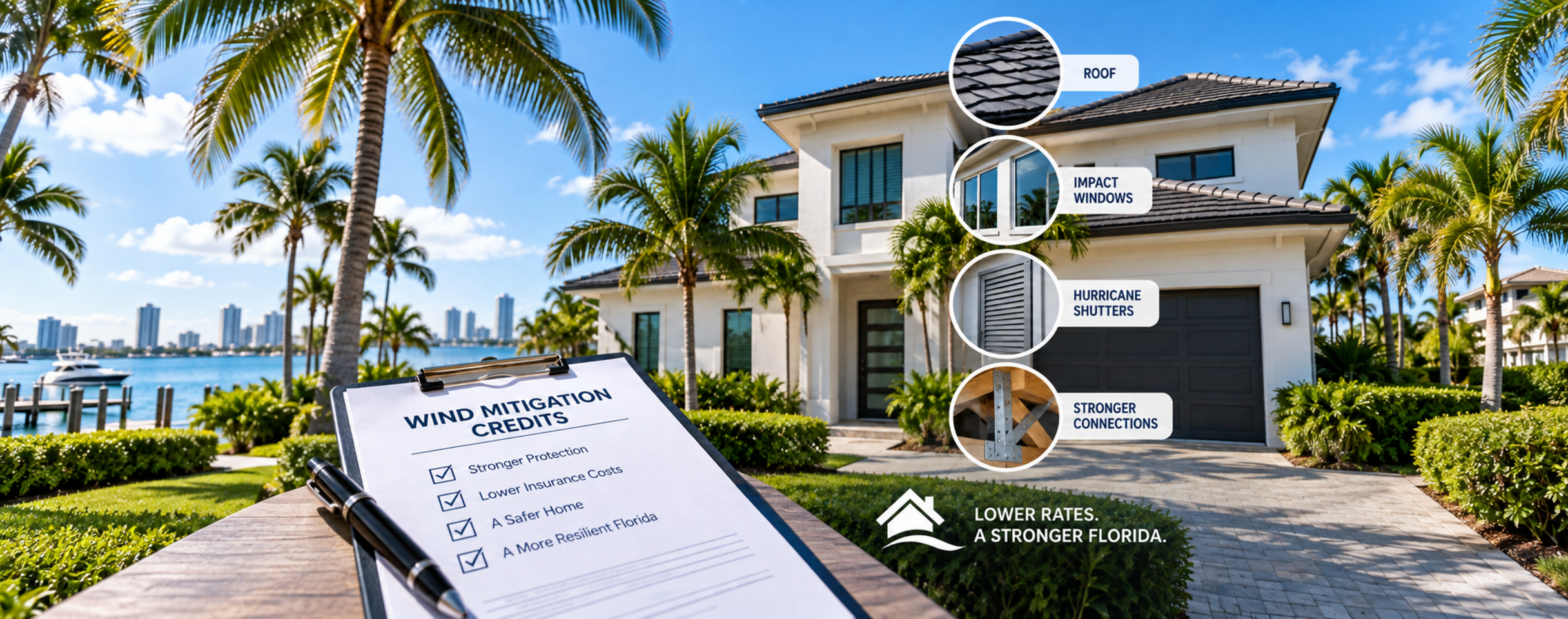
Key takeaways
- The wind mitigation form is the most valuable piece of paper in a South Florida homeowner’s file, and the one most often filled out badly.
- Anyone quoting you a flat percentage saving is guessing. Credits apply to the wind portion of the premium, and that portion varies by home, location, and carrier.
- “Unknown” on the form scores as the least favorable answer — an inaccessible attic can quietly cost you the roof-deck credit.
- Florida adopted a revised form, OIR-B1-1802 Rev. 04/26, for inspections performed on or after April 1, 2026.
- A report is generally valid up to five years, provided no material changes to the structure and no inaccuracies on the form.
The wind mitigation form is the most valuable piece of paper in a South Florida homeowner’s file. It is also the one most often filled out badly.
Nobody can promise you a specific discount from it. What it does is prove the house was built or retrofitted to withstand a hurricane — and without that proof, the carrier assumes the worst on every line. The value of the credits depends on the insurer’s filed rating plan, the home, its location, and which features actually get documented.
What is a wind mitigation inspection?
A qualified inspector documents wind-resistant construction features on Florida’s Uniform Mitigation Verification Inspection Form, known by its state designation OIR-B1-1802. The completed report goes to your insurance agent or carrier so eligible credits can be applied.
It is not the same thing as a four-point inspection, and the two get confused constantly:
| Wind mitigation inspection | Four-point inspection | |
|---|---|---|
| Purpose | Documents wind-resistant features so credits can be applied | Assesses general condition for eligibility and underwriting |
| What it examines | Roof covering, deck attachment, roof-to-wall connection, roof shape, secondary water resistance, opening protection | Roof, electrical, plumbing, and HVAC systems |
| Effect on premium | Can reduce the wind portion of the premium | Generally affects whether a carrier will write or renew the risk |
| Typical trigger | New policy, renewal, reroof, or mitigation upgrade | Older home, new carrier, or carrier underwriting rule |
Florida law requires insurers to offer actuarially reasonable discounts for windstorm mitigation — the requirement sits in Florida Statute § 627.0629. But the statute requires the discounts to exist; it does not set the number. That comes from each carrier’s filed rating plan.
What changed on the Florida wind mitigation form in 2026?
If your last inspection was done before this year, this is worth knowing.
Florida adopted a revised Uniform Mitigation Verification Inspection Form — OIR-B1-1802 Rev. 04/26 — for inspections performed on or after April 1, 2026, under Rule 69O-170.0155 of the Florida Administrative Code. The prior version, Rev. 01/12, had been in use since 2012.
Two practical consequences:
- An inspection performed on or after April 1, 2026 needs to be on the revised form. A report written on the retired version after that date is likely to be rejected.
- A valid report completed before that date generally remains usable within its normal validity window. The form change did not expire anyone’s existing report.
The broader direction of the revision is toward more documentation — carriers may request photos, permits, and product approvals to support the features claimed. That makes the preparation steps further down this page more important than they used to be, not less.
Form requirements and carrier acceptance rules change. Confirm the current form version and your carrier’s requirements before ordering an inspection.
What the seven categories on the form document
| Category | What the inspector documents | Why it matters |
|---|---|---|
| Building code | Whether the structure was built, or the roof permitted, under an eligible code standard | Sets the baseline for how the home is rated |
| Roof covering | Roof-covering type, permit date, and evidence it meets an applicable code standard | An undocumented reroof is priced as though it never happened |
| Roof-deck attachment | How the sheathing is fastened to the structure, including fastener type and spacing | Requires attic access to verify — the most commonly lost credit |
| Roof-to-wall connection | The method connecting roof structure to walls | Often the second-largest credit driver after opening protection |
| Roof geometry | Whether the roof meets the form’s hip definition, including limits on non-hip perimeter | Hip roofs generally perform better in wind |
| Secondary water resistance | A qualifying layer or system reducing water intrusion if the covering fails | Usually only addable during a reroof |
| Opening protection | Documented protection level for windows, exterior doors, skylights, and other required openings | Typically the largest single credit driver |
Roof-to-wall connections, weakest to strongest
The form distinguishes between several connection methods. In general terms, from least to most wind-resistant:
| Connection type | What it is |
|---|---|
| Toe nails | Nails driven at an angle through the truss or rafter into the top plate |
| Clips | Metal connectors attached to the truss and the wall, without wrapping over the top |
| Single wraps | A metal strap that wraps over the top of the truss and attaches to the wall |
| Double wraps | Straps on both sides of the truss, wrapping over the top — generally the strongest classification |
The precise definitions on the form are specific about fastener counts and placement, so this is genuinely a matter for the inspector to determine rather than something to eyeball from the attic hatch. But knowing the ladder helps you understand what a contractor is proposing during a reroof.
Opening protection
The strongest opening-protection classification generally requires that all required openings be protected to the applicable standard — not most of them. This is where a great deal of money gets left behind in South Florida.
A house can have impact glass on three sides and still miss the top classification because of one unrated bathroom window, a skylight, or a garage door that was never upgraded. The word that matters is every.
So how much can wind mitigation actually save?
Anyone who quotes you a flat percentage is guessing.
Credits apply to the wind portion of the premium, and the wind portion is only one component of the total policy price. Taxes, assessments, non-wind coverage, deductibles, and other rating factors remain regardless of what the form says.
Here is the shape of the calculation — an illustration, not a quote:
| Line | Amount |
|---|---|
| Total annual premium | $8,000 |
| Portion attributable to wind | $5,000 |
| Hypothetical 20% reduction to the wind portion | −$1,000 |
| Resulting premium | $7,000 |
| Effective reduction on the total bill | 12.5%, not 20% |
Real carrier math is messier than this. Minimum premiums, caps, and interacting rating factors all apply. Treat the table as the structure of the calculation, not the answer for your house.
The wind portion also varies enormously by location. A coastal home in Sunny Isles Beach or Fort Lauderdale carries a much larger wind component than an inland property in Weston or Doral — which means identical credits produce very different dollar results on two otherwise similar homes.
Which mitigation upgrades usually matter most?
Usually opening protection, then roof-to-wall connection. But the answer is house-specific, and the wrong upgrade can cost five figures and return almost nothing in premium savings.
Before spending money, ask an inspector, a contractor, and your insurance agent to compare the upgrade cost against the estimated premium effect. In rough order of how often they pay off:
- Protecting all required openings with qualifying impact windows, doors, shutters, or panels.
- Improving roof-to-wall connections during a reroof or major renovation, when the structure is already open.
- Documenting a qualifying roof-deck attachment when the existing attachment is stronger than the prior report shows.
- Adding a qualifying secondary water-resistance system when practical during a reroof.
- Correcting report errors with permits, product approvals, photos, and contractor documentation — the cheapest item on this list and often the most overlooked.
These credits also show up when you lower a South Florida homeowners insurance premium the right way — by documenting the house, not by guessing at discounts.
Why homeowners miss credits they already qualify for
The single most expensive word on the form
If the inspector cannot verify a feature, it is marked unknown — and unknown scores as the least favorable option available. That is how an inaccessible attic quietly costs you the roof-deck credit on a house that would have earned it.
The other common reasons:
- The report is outside the age window the carrier will accept, or the insurer has requested a newer one.
- Only some openings are protected, preventing the strongest opening-protection classification.
- Permits, product approvals, invoices, or installation records are missing.
- The work was done and nobody told the carrier. A reroof or a full impact-window job can sit in the county permit record for years while the policy still prices the old roof.
- The form contains conflicting answers, inadequate photos, or an inspector-licensing problem.
How to prepare for your wind mitigation inspection
A little preparation is the difference between a form that documents your house and one that documents what the inspector could reach.
- Gather roof permits, reroof contracts, paid invoices, and inspection records.
- Locate product-approval labels or paperwork for impact windows, doors, shutters, and garage doors.
- Make the attic safely accessible so the inspector can view fasteners and roof-to-wall connections.
- Point out additions, flat-roof sections, skylights, and enclosed areas before the inspection starts.
- Review the completed form and photos for accuracy before it goes to your agent.
That last step is the one people skip. A perfect report sitting in a drawer does nothing. It has to reach the carrier and be applied.
Frequently asked questions
How long is a wind mitigation inspection valid in Florida?
A Uniform Mitigation Verification Inspection Form is generally valid for up to five years, provided no material changes have been made to the structure and no inaccuracies are found on the form. Individual carrier underwriting rules can differ, so confirm the requirement with your insurer before relying on an older report.
Do I need a new inspection because the form changed in 2026?
Not necessarily. Inspections performed on or after April 1, 2026 must use the revised OIR-B1-1802 Rev. 04/26, but a valid report completed before that date generally remains usable within its normal validity window. Get a new inspection when your report is aging out, or when you have made changes that would improve the rated features.
Do impact windows automatically qualify for the best discount?
Not automatically. The products and the installation must qualify, and all required openings must meet the applicable standard for the strongest classification. Three sides of impact glass and one unrated opening generally does not get you there.
Does a hip roof receive a wind mitigation credit?
A qualifying hip-roof geometry may earn a credit, subject to the insurer’s rating plan and the precise definition used on the form — which includes limits on how much of the perimeter can be non-hip.
Is a wind mitigation inspection required in Florida?
It may not be legally required for every policy, but without acceptable documentation the insurer generally cannot apply credits for features it cannot verify. In practice, going without one means paying as though the house has none of them.
Can I submit a new inspection in the middle of my policy term?
Many carriers will review new mitigation documentation midterm, but effective dates and underwriting procedures vary. Some apply the change at the next renewal rather than retroactively. Ask before you order the inspection so you know what to expect.
Does a new roof require a new wind mitigation inspection?
A reroof changes several of the rated features — roof covering, potentially deck attachment and secondary water resistance — so a new inspection after the work is completed and permitted is usually worth ordering. This is one of the most common situations where a homeowner is paying on outdated information.
Who is allowed to perform a wind mitigation inspection?
Florida limits who may complete and sign the form to specific licensed categories, including licensed home inspectors and certain licensed contractors and design professionals. Verify the inspector’s license before the inspection — a licensing problem on the form can invalidate the credits.
Find out whether your home is receiving the credits it qualifies for
Alltrust Insurance Group can review your current wind mitigation report and declarations page, identify the questions worth raising with your inspector, and request carrier-specific pricing with every documented feature applied.
If your report is more than a few years old, or you have reroofed or upgraded openings since it was written, that review is usually the highest-return hour you will spend on your policy this year.
Credits, discounts, eligibility, form versions, and carrier acceptance rules vary by insurer, property, inspection findings, and filed rating plan, and change over time. Wind mitigation credits are not guaranteed. This guide is general information, not a quote or a policy. The insurance contract controls.