
Key takeaways
- Miami is one of the most expensive places in the country to insure a car, and ZIP code is a smaller part of that than most drivers assume.
- Florida’s minimum requirement does not include bodily injury liability — the coverage that pays when you injure someone else.
- $10,000 of property damage liability does not total a late-model SUV in this market. The rest is yours.
- The fastest real saving comes from comparing equivalent coverage, not from finding a cheaper number with things quietly removed.
- Uninsured and underinsured motorist coverage matters more in Florida than in most states, precisely because bodily injury liability is optional here.
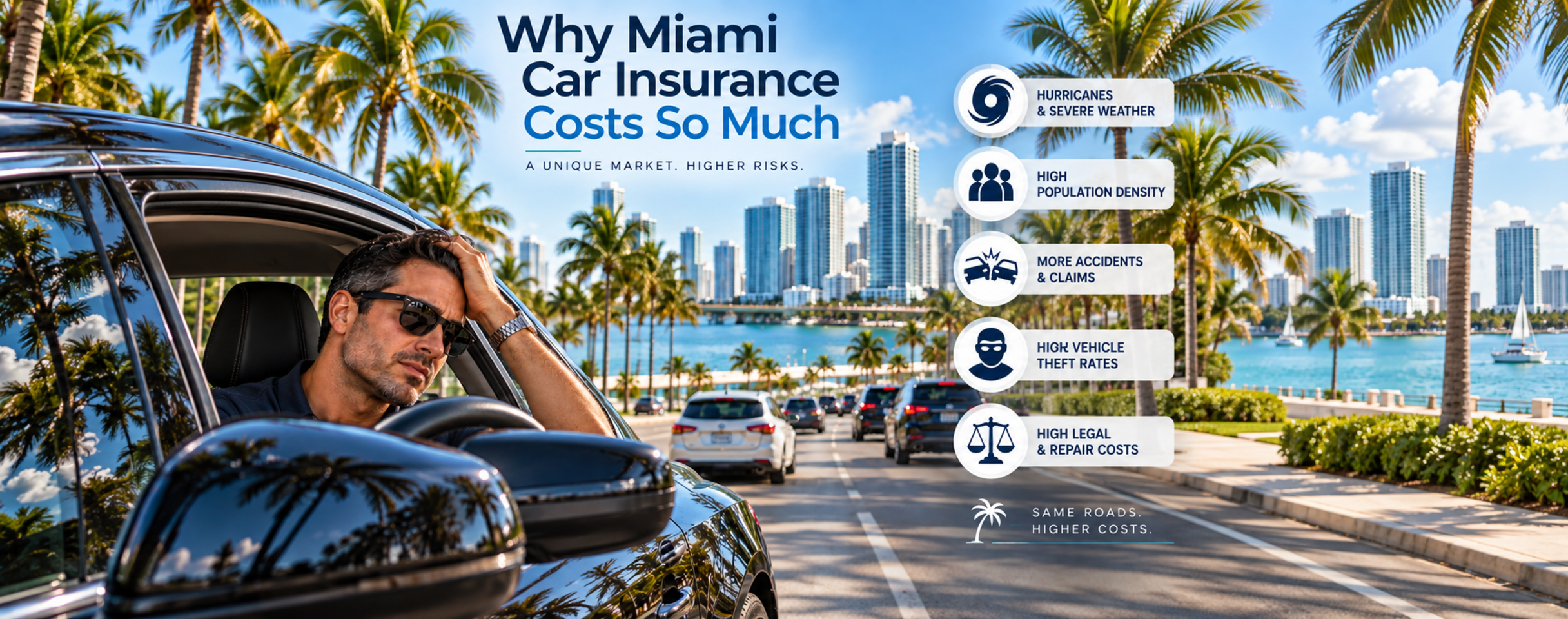
Miami is one of the most expensive places in the country to insure a car, and the reasons are clear: crowded roads, costly repairs, theft, flooding, high medical and litigation costs, and many drivers carrying nothing but state minimums.
Your ZIP code is part of it. It is a smaller part than most people assume. The most effective way to lower Miami car insurance is to compare equivalent coverage, manage the rating factors you can actually control, and avoid the kind of savings that leave you dangerously underinsured.
Why is car insurance so expensive in Miami?
| Cost driver | What it means for your premium |
|---|---|
| Traffic and claim frequency | More vehicles, congested roads, and constant stop-and-go driving create more opportunities for collisions. |
| Costly vehicles and repairs | Modern bumpers, cameras, sensors, headlights, and driver-assistance systems turn a moderate impact into an expensive repair. |
| Theft and comprehensive losses | Vehicle theft, vandalism, flooding, falling objects, and storm damage all feed the comprehensive-coverage experience. |
| Injury and medical costs | PIP claims, bodily injury claims, and medical treatment costs shape the overall loss environment. |
| Uninsured and underinsured drivers | When the at-fault driver has inadequate coverage, UM/UIM becomes critical — and buying it adds to the premium. |
| Fraud and litigation | Fraudulent or inflated claims and the legal expense that follows raise loss costs for everyone in the pool. |
| Personal rating factors | Driving record, age, household drivers, vehicle, annual mileage, garaging location, coverage history, limits, and deductibles. |
The last row holds most of the controllable savings. Territory matters, but a clean record, accurate household information, and the right limits and deductibles move a Miami quote further than moving a few miles inland would.
What is Florida’s minimum car insurance requirement?
For most Florida-registered vehicles, the state requires at least $10,000 of Personal Injury Protection (PIP) and $10,000 of Property Damage Liability (PDL), maintained continuously while the registration is active.
Notice what is missing:
| Coverage | Required in Florida? | What it does |
|---|---|---|
| Personal Injury Protection (PIP) | Yes — $10,000 minimum | Pays a portion of your own medical expenses regardless of fault |
| Property Damage Liability (PDL) | Yes — $10,000 minimum | Pays for damage you cause to someone else’s property |
| Bodily Injury Liability (BI) | No, for most drivers | Pays for injuries you cause to other people |
| Uninsured/Underinsured Motorist | No — must be offered | Protects you when the at-fault driver has inadequate coverage |
| Collision | No — lender may require | Repairs your own vehicle after a collision |
| Comprehensive | No — lender may require | Theft, flood, vandalism, storm damage, falling objects |
Florida does not require most drivers to carry any coverage for injuries they cause someone else. That is why the state minimum is nowhere near full coverage, and why it is worth knowing exactly what you have rather than assuming registration compliance means you are protected.
A lender or leasing company will also typically require comprehensive and collision coverage, subject to its contract.
The $10,000 problem
$10,000 in property damage liability doesn't cover a late-model SUV in this market, let alone a luxury car or a three-vehicle pileup on the Palmetto. Whatever is left over is yours — and in Florida, a judgment can follow your wages and your assets. Ask for higher-limit options before settling for minimum coverage.
Is Florida repealing PIP?
This comes up constantly, and a lot of confusing information is online — including articles written as though a repeal has already taken effect.
Here is the situation as of September 2026: Florida’s no-fault PIP requirement remains in effect. Bills to repeal PIP and replace it with mandatory bodily injury liability limits have been filed repeatedly in recent legislative sessions and have not been signed into law. Proposals have generally contemplated minimum bodily injury limits of $25,000 per person and $50,000 per accident, with property damage liability staying at $10,000.
What that means practically:
- You still need PIP and PDL to register a vehicle in Florida today.
- If a repeal does pass in a future session, drivers carrying only state minimums would see the largest change — anyone already carrying meaningful bodily injury limits is closer to where the proposals would land.
- Carrying bodily injury liability and UM/UIM now is a reasonable decision regardless of what the legislature does, because the exposure exists either way.
Legislative status changes. Confirm the current requirement before relying on this section — and update the date stamp on this article whenever the status changes.
12 ways to lower your Miami car insurance
- Shop several carriers, but keep everything else the same. Keep drivers, vehicles, limits, deductibles, and endorsements the same. Otherwise, you are not comparing price; you are comparing coverage. Start with our auto quote tools and keep coverage consistent.
- Bundle where the whole package is competitive. Auto with homeowners, condo, renters, or umbrella. See also how to lower a South Florida homeowners premium.
- Increase comprehensive and collision deductibles — to an amount you could actually pay after a loss, not just the one that quotes best.
- Maintain continuous coverage and avoid cancellation for nonpayment. A lapse is one of the more expensive things you can do to a future quote.
- Review annual mileage, commute use, garaging address, and household drivers for accuracy. Stale information often costs money in both directions.
- Ask about telematics or usage-based programs if you are comfortable sharing driving data and the program terms fit how you actually drive.
- Use the discounts that apply: multi-car, good student, defensive driving, vehicle safety features, paperless billing, automatic payments.
- Compare insurance costs before buying or leasing. Trim level, performance, parts prices, and theft experience all matter, sometimes more than the sticker difference.
- Dropping collision on an older car can make sense — but run the numbers. A common rule of thumb is to keep it as long as it costs less than roughly 10% of the car’s value per year, and only drop it if you could replace the car out of pocket.
- Keep credit-related information healthy where legally permitted and used by the insurer, and correct material errors in consumer reports.
- Ask whether paying the term in full beats installments once fees are counted.
- Review youthful drivers, excluded-driver rules, and vehicle assignments with your agent — accurately, and before a claim, not after.
Coverage to be careful about cutting
Some savings are real. Others move risk onto you and call it a discount. Be deliberate about these:
- Bodily injury liability — protects against injuries you cause and may help defend covered lawsuits.
- Uninsured/underinsured motorist — protects you and eligible occupants when the at-fault driver lacks adequate limits. This matters more in Florida than in most states, precisely because bodily injury liability is optional here.
- Property damage liability — especially in an area with this many expensive vehicles on the road.
- Comprehensive — if the vehicle is exposed to theft, flooding, vandalism, or storm damage. In South Florida, all four apply.
- Rental reimbursement and roadside assistance — if you have no practical alternative after a covered loss or breakdown.
How to compare Miami auto insurance quotes correctly
The cheapest quote in the stack is usually cheapest for a reason, and the reason is usually something that was taken out. Put quotes side by side and confirm every line:
| Check this | Why it matters |
|---|---|
| Bodily injury limits | The single largest difference between two quotes is often here. |
| Property damage limit | Minimum limits don't go far enough for current vehicle values. |
| PIP options and deductible | PIP can be written several ways, and they do not cost the same |
| Uninsured motorist selection | Stacked, unstacked, or rejected — check which one you were quoted |
| Medical payments | Optional where offered; easy to add or drop without noticing |
| Comprehensive and collision deductibles | A cheaper quote is often just a higher deductible. |
| Rental reimbursement and roadside | Commonly stripped out to win on price. |
| Custom equipment and gap coverage | Matters on financed, leased, or modified vehicles |
| Driver and vehicle exclusions | An excluded driver is a coverage gap, not a discount. |
Then ask the one question that settles it: what was taken out to get to this number?
Frequently asked questions
Why did my Miami car insurance increase without an accident?
Rates can change because of carrier-wide loss experience, repair and medical inflation, territory changes, vehicle factors, or a discount falling off. None of those require anything to have happened to you. Ask for a renewal review and a written comparison rather than accepting the new number.
Does ZIP code affect car insurance in Miami?
Garaging territory is commonly a rating factor, because claim frequency and severity genuinely vary by area. But it is weighed alongside many personal and vehicle factors, and it usually makes up a smaller share of the premium than drivers assume.
Is minimum Florida auto insurance enough?
It satisfies basic registration requirements for many drivers, but it leaves large gaps — most importantly, no coverage for injuries you cause to other people. Discuss higher limits based on your assets and your actual exposure.
Does Florida require bodily injury liability insurance?
Not for most drivers. Florida is unusual in this respect. Certain situations — including some following a DUI conviction — do carry higher mandatory limits, so confirm what applies to your record.
What happens if an uninsured driver hits me in Florida?
Your own PIP addresses part of your medical expenses regardless of fault. Beyond that, uninsured/underinsured motorist coverage is generally what responds — and if you rejected it, there may be no coverage for those damages at all. This is the main reason UM/UIM is worth carrying here.
Will raising my deductible lower my premium?
Often, but the savings vary. Compare the annual reduction with the extra you would pay after a comprehensive or collision claim, then decide whether the trade is worth it for your situation.
Should I bundle home and auto insurance?
Bundling can produce discounts, but compare the combined total and the coverage quality against keeping them separate. A bundle discount on a weaker policy is not a saving.
How often should I shop car insurance?
Review at every renewal, and shop after a major rate change, a vehicle change, a move, a household-driver change, or an improvement in your driving history.
Compare Miami and South Florida auto insurance.
Alltrust Insurance Group can compare available auto insurance options while holding coverage limits and deductibles consistent — so what you are looking at is a price difference, not a coverage difference.
Coverage, limits, deductibles, discounts, eligibility, and pricing vary by insurer, driver, vehicle, and underwriting. Statutory requirements change; confirm current Florida law before making coverage decisions. This guide is general information, not a quote or a policy. The insurance contract controls.