
Key takeaways
- A current wind mitigation inspection is usually the single highest-leverage item on a South Florida homeowners policy.
- Wind mitigation credits apply to the wind portion of the premium, not the entire bill.
- Florida hurricane deductibles are a percentage of Coverage A — on an $800,000 home, 5% is a $40,000 out-of-pocket.
- Undocumented improvements cost real money. A 2019 reroof the carrier never recorded is priced as if it never happened.
- Some savings are real, and some move risk onto you. Understanding the difference is worth it before you sign.
South Florida homeowners insurance is expensive, and nothing in this guide will change that. What it can change is how much of your premium comes from bad information rather than real risk.
A roof replacement the carrier never recorded. A wind mitigation form with three features marked unknown. A replacement cost estimate built on the wrong square footage. We see all three constantly. The steps below are the ones that actually move a number, roughly in order of how often they pay off.
Why is South Florida home insurance so expensive?
A South Florida homeowners quote has very little to do with what you paid for the house. Carriers evaluate:
- The estimated cost to rebuild the structure
- Hurricane and wind exposure, including distance from the coast
- Roof age, material, and condition
- Construction type — masonry, frame, or mixed
- Prior claims history on the property and the owner
- Deductible selections, including the hurricane deductible
- Occupancy — primary residence, seasonal, or rental
- Protective devices such as monitored alarms and water shutoff systems
- Documented features that help the home resist wind damage
This is why two houses of the same size on the same block can quote thousands of dollars apart. One owner documented a 2019 reroof and protected every opening. The other left it to the carrier’s imagination.
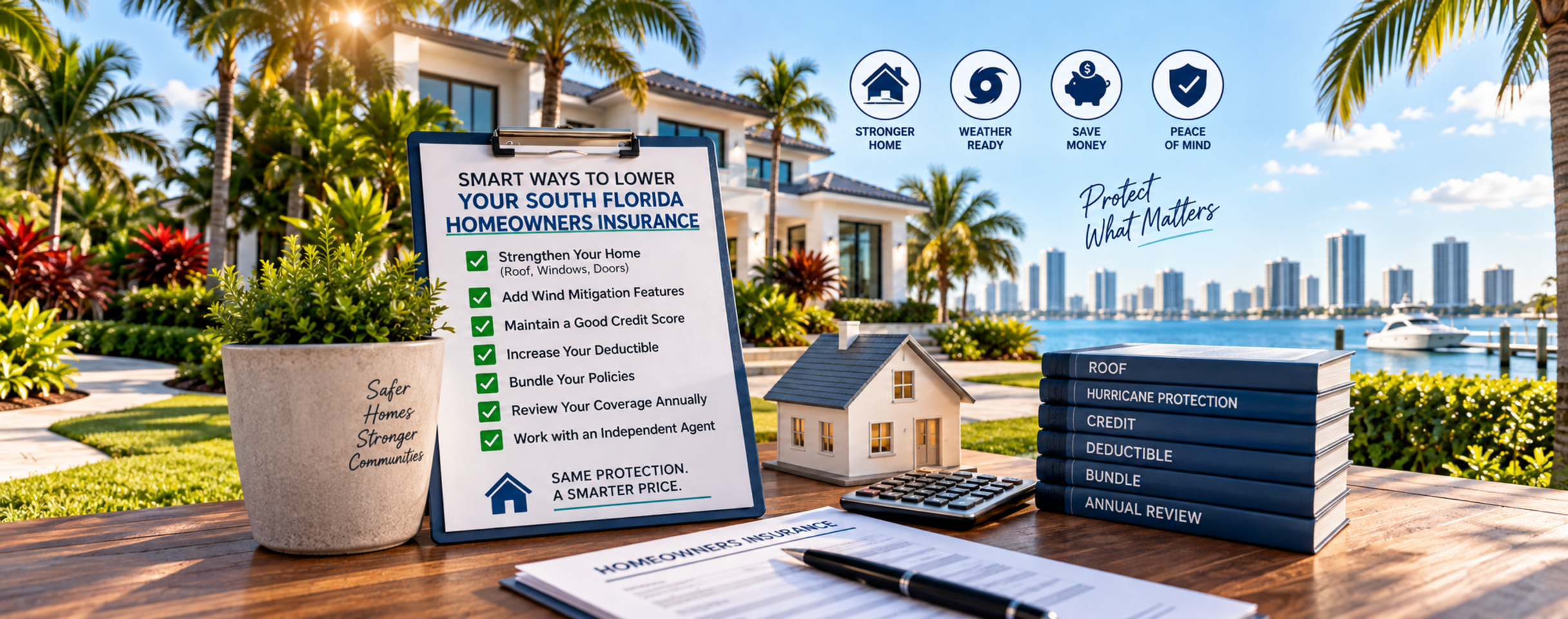
10 practical ways to reduce your homeowners insurance premium
1. Update your wind mitigation inspection
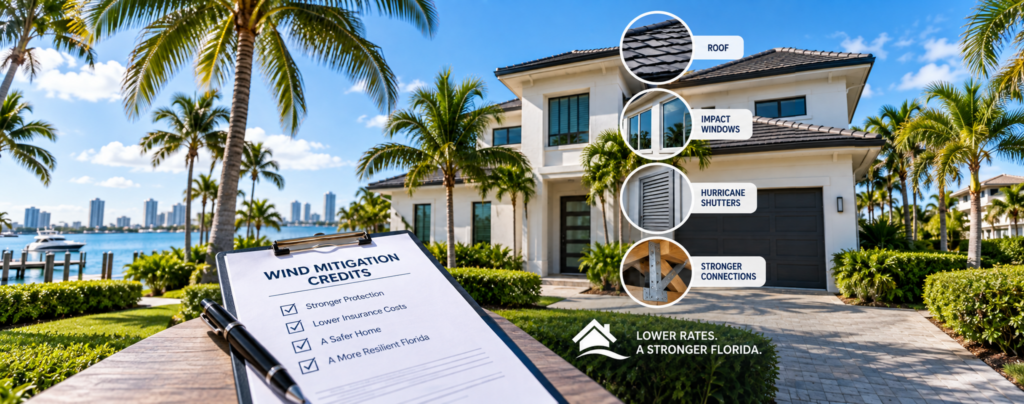
This is the highest-leverage item on the list, which is why it is first. A current wind mitigation report documents the features Florida carriers use to rate wind exposure.
| Feature documented | Why it matters |
|---|---|
| Roof covering | Whether the roof meets current Florida Building Code requirements |
| Roof deck attachment | Nail type and spacing holding the deck to the trusses |
| Roof-to-wall connection | Toe nails, clips, single wraps, or double wraps — a major credit driver |
| Roof geometry | Hip roofs generally perform better in wind than gable roofs. |
| Secondary water resistance | A sealed deck layer beneath the roof covering |
| Opening protection | Impact-rated or properly rated protection on windows, doors, and skylights |
One caveat worth repeating: credits hit the wind portion of the premium, not the whole bill. Read our guide to Florida wind mitigation credits before you order a new inspection.
2. Compare multiple admitted and surplus-lines options
Carrier appetite changes. A company that was competitive last year may not be the best fit at renewal. Compare price together with coverage form, deductibles, exclusions, financial strength, claims service, and roof settlement terms. Start a comparison from our homeowners quote tools.
3. Review the replacement-cost estimate
Coverage A is generally based on the estimated cost to rebuild — not the purchase price, mortgage balance, or land value. Incorrect square footage, construction details, or finishes can distort the estimate. Ask your agent to review the reconstruction-cost inputs, but do not reduce coverage below a reasonable rebuilding estimate to lower the premium.
4. Consider a higher all-other-perils deductible
Increasing the deductible may reduce premium, but only choose an amount you could comfortably pay after a covered loss. Compare the actual annual savings with the extra amount you would be assuming.
5. Evaluate hurricane-deductible options carefully
Florida hurricane deductibles are a percentage of Coverage A, not a flat dollar figure, and the math catches people off guard. Here is what the commonly offered percentages actually cost at different coverage amounts:
| Coverage A | 2% deductible | 5% deductible | 10% deductible |
|---|---|---|---|
| $400,000 | $8,000 | $20,000 | $40,000 |
| $600,000 | $12,000 | $30,000 | $60,000 |
| $800,000 | $16,000 | $40,000 | $80,000 |
| $1,200,000 | $24,000 | $60,000 | $120,000 |
Moving from 2% to 5% will lower the premium. On an $800,000 home, it also means writing a $40,000 check before the policy pays anything. Run the percentage into dollars before you decide.
6. Keep the roof insurable
Roof age, material, condition, permits, and remaining useful life can materially affect both eligibility and pricing. Maintain permit records, paid invoices, and photos. If the roof has been replaced, make sure carrier and county records reflect the correct completion date—this is one of the most common and most expensive record-keeping failures we see.
7. Protect every opening
Impact-rated windows and doors, or properly rated shutters, may improve both safety and insurance credits. The word that matters is every. A house can have impact glass on three sides and still miss the strongest opening-protection classification because of one bathroom window, a skylight, or an unrated garage door.
8. Ask about protective-device and policy discounts
Depending on the carrier, monitored burglar or fire alarms, sprinklers, gated-community protection, water-leak detection, automatic shutoff devices, newer construction, paperless billing, or advance quoting may qualify for credits. These are individually small but collectively meaningful—and carriers generally don't apply them unless someone asks.
9. Avoid lapses and report information accurately
A lapse in coverage can reduce options or increase cost. Confirm occupancy, ownership, prior claims, rental activity, business use, and household information accurately. Never omit a material fact to obtain a lower quote — it can affect the claim you eventually file.
10. Review optional coverages instead of deleting them unthinkingly
Water backup, equipment breakdown, screened-enclosure coverage, ordinance or law, replacement cost on contents, and higher liability limits can all be valuable. Ask what each endorsement costs and what it protects before removing it.
Best first move
Send your agent the current declarations page, wind mitigation report, four-point inspection (when applicable), roof permit or invoice, alarm certificates, and a short list of upgrades. Partial information gets you a partial comparison, and that is usually why a quote looks great until underwriting opens the file.
Which savings create a coverage tradeoff?
Not every premium reduction is a win. These lower the number by moving risk back onto you:
- Raising deductibles transfers more of each loss to you.
- Reducing personal property, loss-of-use, or liability limits can leave real gaps.
- Choosing actual cash value instead of replacement cost may increase depreciation after a loss.
- Excluding wind coverage can dramatically change the protection, and a lender may not accept it.
- A restricted repair-network or managed-repair endorsement may reduce premium but limit how repairs are handled.
None of these are automatically wrong. They are decisions, and you should make them with the dollar figures in front of you rather than as a line item someone removed to hit a target price.
What changes by county in South Florida?
Rating factors are not uniform across the region. A few patterns worth knowing:
- Miami-Dade County — The strictest building code requirements in the state, which cuts both ways: newer construction often rates well, while older homes in Miami Beach, Sunny Isles Beach, and Bal Harbour face coastal wind exposure that drives the wind portion of the premium.
- Broward County — Wide variation between coastal cities such as Fort Lauderdale and Hollywood and inland communities like Weston and Pembroke Pines. Distance to coast matters more here than most owners expect.
- Palm Beach County — Carrier appetite varies considerably between the coastal corridor and the western communities, so market availability itself can be the deciding factor on price.
Because appetite shifts by territory and by carrier, the same property can be a high risk to one insurer and a decline to another. That is the practical argument for comparing several markets rather than renewing on autopilot.
Frequently asked questions
Does a new roof lower homeowners insurance in Florida?
It can improve eligibility and may affect pricing, especially when the work is permitted and the updated roof-covering or attachment features are documented on a wind mitigation report. Results vary by home and carrier — but an undocumented new roof rarely helps at all.
How much can wind mitigation credits actually save?
There is no fixed figure. Credits apply to the wind portion of the premium, and how much of your total bill that represents depends on the property, its location, and the carrier. A coastal home carries a larger wind component than an inland one, so the same credits produce a different dollar result.
Why did my Florida homeowners insurance go up at renewal?
Common drivers include an aging roof crossing a carrier threshold, changes in reconstruction-cost estimates, carrier-wide rate filings, changes in the reinsurance market, claims activity, or an expired wind mitigation report. Ask your agent which specific factor changed rather than accepting the new number.
Is the cheapest South Florida homeowners policy the best policy?
Not necessarily. Compare exclusions, deductibles, roof settlement terms, water coverage, ordinance or law, liability limits, and the insurer’s claims and financial profile — not price alone. The difference between two policies usually shows up at claim time, not at binding.
Should I raise my hurricane deductible to save money?
Only after converting the percentage into dollars and confirming you could pay that amount after a hurricane. Ask for side-by-side quotes so you can compare annual savings with the added exposure.
How often should I shop homeowners insurance in Florida?
Review the policy at every renewal, and shop when the premium, coverage, carrier appetite, or property details have materially changed. In the current Florida market, appetite shifts often enough that an annual review is reasonable.
Can an independent insurance agent compare several carriers?
An independent agent may be able to approach multiple insurers, although available markets vary by property and by agency appointments. That is different from a captive agent, who represents one company.
Get a South Florida homeowners insurance review.
Alltrust Insurance Group can review your current policy, property information, and available mitigation documents, then compare appropriate options for your South Florida home.
Coverage, credits, deductibles, eligibility, and pricing vary by insurer, property, and underwriting. Discounts and mitigation credits are not guaranteed and depend on carrier filings and inspection results. This guide is general information, not a quote or a policy. The insurance contract controls.